
September is National Biodiversity Month
This is a time to celebrate our natural wonders and diverse ecosystems. Biodiversity Month offers us the perfect opportunity to pause and appreciate the beauty, complexity, and importance of our biodiversity.
Biodiversity Month also encourages us to reflect on our relationship with the natural world and take action to protect it. Nationally the aim is to ensure our important environments and habitats are preserved for future generations of Australians to appreciate and enjoy.
Why Australia focuses on biodiversity
Our wildlife is unique: Australia is one of only 17 “mega-diverse” nations in the world. Roughly 84% of its plants, 83% of its mammals, and 45% of its birds are endemic, meaning they exist nowhere else on Earth.
High Risk of Extinction: Decades of habitat loss, climate change, pollution, and invasive species have placed immense pressure on native species.
Action: The month helps connect people with nature, to encourage and celebrate action to protect habitat, ecosystems and our biodiversity.
Threatened Species Day: Biodiversity Month features National Threatened Species Day on September 7th, which marks the anniversary of the death of the last Tasmanian tiger in 1936. A day to remember species lost to extinction, focus attention on animals and plants currently at risk and reflect on our impact on nature and how we may augment biodiversity.
Nature is essential to our survival and wellbeing.
Nature provides the building blocks for our survival, such as food, clean air, water, soil and shelter. Nature also supports our health and wellbeing, and our economy. In Port Stephens we can appreciate the critical connection between nature, our lifestyle and our economy.
We need nature, but these days nature also needs us ~ to protect what remains and restore habitat where possible.
What is happening locally?
The Port Stephens Local Government Area (LGA) is home to a rich but highly vulnerable ecosystem, with over 100 officially observed threatened species documented across its land and marine environments.
Tomaree National Park protects a rich and diverse mix of coastal, forest, and wetland ecosystems that support many native plants and vulnerable wildlife species. It protects:
- over 25 threatened native species, and
- two Endangered Ecological Communities (Freshwater Wetlands and Swamp Sclerophyll Forest on Coastal Floodplains).
Giving our biodiversity a helping hand ~ just 6 of the many projects making a difference in Tomaree National Park
1/ Threatened Mintbush gets a boost from SOS and Friends
2/ Beauty and a beast ~ invasive garden plants threaten bush habitats
~ you can petition to help manage Polygala
3/ Restoring an Endangered Ecological Community: Littoral Rainforest
4/ Advocating to protect biodiverse sensitive land
5/ Threatening invasive weeds reduce biodiversity ~ community partnerships
6/ Connecting people with nature
in1/ Threatened Mintbush gets a boost from SOS and Friends
Save Our Species (SOS) program is active insuring that threatened Villous Mintbush, Prostanthera densa, is here into the future. Around 2020, there were only about 80 plants known at a couple of locations in Nelson Bay (and these were outside the national park). The next known population in the Sydney area also had just as few known plants, though a healthy population was in Jervis Bay. Together these disjunct mint bush populations were not looking good to survive into the future.
SOS started active planting in 2020 in Tomaree National Park with two trial sites. Through their community involvement with the Friends of Tomaree National Park (who incidentally talked with local naturalist Philip Diemar) a natural hidden population was located, more than doubling the number of plants previously found in the Nelson Bay Area. Fantastic news! Another population with potentially a little more genetic diversity for cuttings and on growing.
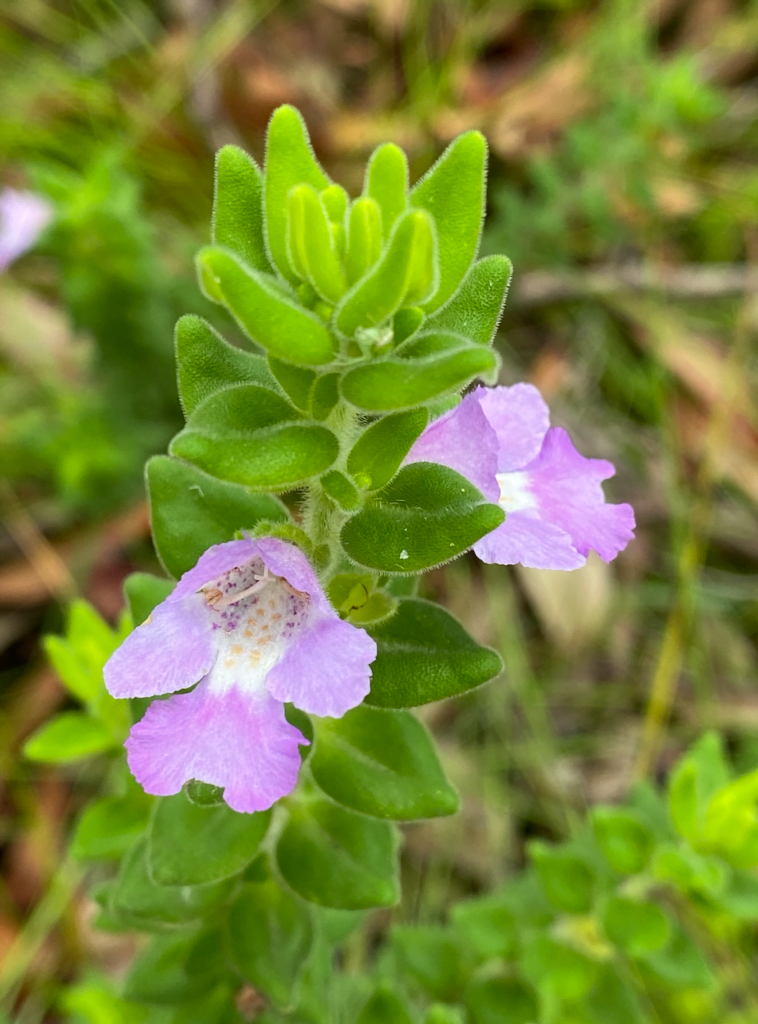
Prostanthera densa is an erect mint-smelling shrub that can grow up to 1-2m tall. Its branches and leaves are covered with long, spreading hairs. Tubular mauve flowers have white and orange throat markings.

Above: Admiring a thriving threatened Villous Mintbush just two years on from planting. Below: Students are hands on (from NSW media release)

Friends of Tomaree National Park also trialled a couple of planting sites, using described criteria like a clay sandy soil, dappled sun around a 40+m altitude and other aspects, and have successfully grown 60+ plants to complement similar sized SOS plantings elsewhere in Tomaree National Park. Read more Boosting a threatened mint bush in Tomaree. Most recently SOS have also involved students in saving the rare threatened plant, taking cuttings, potting up, to eventually grow a new population of Villous Mintbush.
2/ Beauty and a beast ~ invasive garden plants threaten bush habitats
Sweet Pea, butterfly bush, myrtle-leaf milkwort or Polygala myrtifolia is a beauty and a beast. It is a hardy pretty purple pea sold in commercial nurseries but escapes from our gardens and invades native bushland. It is prevalent around Nelson Head where it wass planted, and is throughout the western dunes of Shoal Bay, gradually replacing native bush and reducing biodiversity. Friends of Tomaree National Park over 5 years are have worked to control it on the northern end of Tomaree National Park, where it is now manageable but not yet eliminated.

Sweet Peas is one of many garden escapees sold commercially. Throughout Port Stephens LGA, Council landcare groups work to manage these weeds to restore biodiversity.
3/ Restoring an Endangered Ecological Community: Littoral Rainforest
Take a walk from the Boat Harbour northern entrance at Ocean Parade and follow the forest edge along the Tomaree Coastal Walk until the informal path leaves the open area and dives into the bush. Here Friends of Tomaree National Park and community volunteers planted about 600+ trees, shrubs and groundcovers to start restoring and extending the tiny remaining remnant littoral rainforest. Just a hint of rainforest magic where the path approaches a tiny bridge over an intermittent creek ~ this charming remnant is shadier with a vitally different feel. North entrance planting >>


In contrast to littoral rainforest, sunset backs the planting (depicted) at the southern Boat Harbour entrance to the Tomaree Coastal Walk at the Lookout Carpark opposite Windsong Way on Kingsley Drive.
Altogether, over 1700 plants are restoring the biodiversity to the north and south of the Boat Harbour entrances to the Tomaree Coastal Walk. Read more >>

Around the Tomaree Peninsula, more extensive littoral rainforest is at
- Soldiers Point in the Green Play Point, Kent Gardens and George Reserve areas. Port Stephens Council’s Littoral Rainforest Project, includes Management and Action plans, and a Littoral Rainforest poster of the plants & animals
- at Salamander Bay near Homestead St, and
- at Nelson Head near the headland, featuring a wind-sheared littoral rainforest canopy.
4/ Advocating to protect biodiverse sensitive land
Fishermans Bay: Recently, environmental groups gathered to remind State government of their commitment to protect a 30 ha block in Fishermans Bay adjacent to Tomaree National Park. In partnership with several local and regional conservation groups, our combined submission demonstrated the area’s high values.
With 6 threatened species recorded — Koala, Squirrel Glider, Eastern False Pipistrelle (microbat), Little Bentwing Bat, Powerful Owl and Giant Dragonfly (Petalura gigantea) while the endangered Mahony’s toadlet (Uperoleia mahonyi) is found in nearby wallum heathland — plus assessments showing its habitat is very suitable to potentially contain another 25 known threatened species.
A wonderful wetland is part of the site.

With over 5 years in the pipeline since its development was stopped, we were hopeful for a celebratory announcement during Biodiversity Month. Representatives from environmental groups met with MP Kate Washington to discuss what was happening following commitments to protect the land. See June 2026 story.

Kate Washington MP, local community group members, and residents, inspect the Landcom site at Fishermans Bay and the recent weed treatment work undertaken by the Friends of Tomaree National Park.
5/ Threatening invasive weeds reduce biodiversity ~ community partnerships
Invasive weeds are a growing issue in public lands and protected reserves, particularly where disturbance enables weeds to get a foothold. The worst weeds smother native bushland, thereby significantly reducing biodiversity. Throughout Council land and Tomaree National Park volunteers contribute substantially to managing weeds in public lands and reserves. See some of the Council landcare sites and projects, and the significant milestones Friends of Tomaree National Park achieved in their first four years.
Bitou bush is a highly invasive weed along the coastal regions of eastern Australia, spanning from south-eastern Queensland to parts of Victoria. First found at Stockton in 1908, Bitou was favoured to rehabilitate after sandmining until its devastating invasiveness was recognised.
Friends of Tomaree National Park are battling bitou bush with success, from Tomaree headland south to Anna Bay, and many locations in between, as part of their regular community bush regeneration sessions. For instance, at Zenith Beach where the group first started (other than the headlands too steep to reach), much of the habitat has recovered after removing bitou and lantana bushes. Seedling removal will be ongoing, with annual checks, until the soil’s seed bank is exhausted. Polygala unfortunately is more persistent and harder to manage.
Community events like those at One Mile / Morna Point Headland have featured fantastic partnerships to help manage bitou along the Tomaree Coastal Walk from One Mile Beach. Together we are making great progress ~ see more here. As part of Biodiversity Month Saturday 26th September, we’ll continue our work with the Australian Climbing Association (ACA) NSW who are also committed to making an impact on the steeper areas up from the rocks. Saturday 7 November we’ll return to further progress our works with ACA NSW and with the local tourist business Escape EcoAdventures. You’re also invited to come along ~ information and registration.


6/ Connecting people with nature
Landcare sessions are a great opportunity to immerse yourself in nature ~ sure sometimes it is the ugly side with weeds, but you always see some beauty you know you are protecting.


Friends of Tomaree National Park also lead guided wildflower walks to help locals learn about the diversity of spring wildflowers in just a tiny patch of Tomaree National Park ~ and produce a brochure to help learning and to enable self-guided walks.
