
Creating more tree hollows
Story by Liz Wynn, Sue Olsson and Ewa Meyer, EcoNetwork
Port Stephens is home to a rich variety of native Australian wildlife that relies heavily on tree hollows for survival.
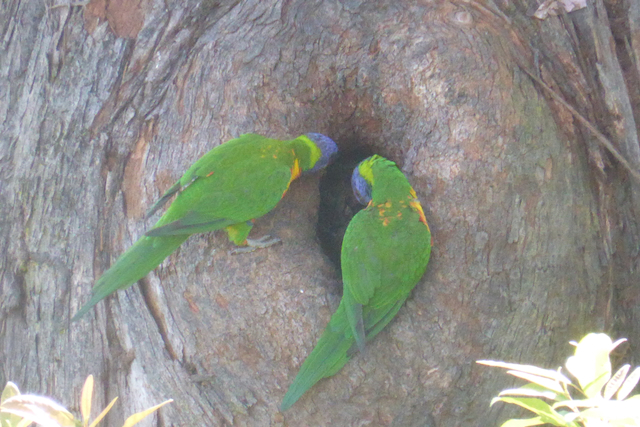
Hollow-bearing trees are especially important for many species. They provide vital natural microhabitats that provide shelter, breeding sites, roosting spots, and protection from predators and weather for hundreds of native Australian species including offering refuge during bushfires and extreme heat, and some collect rainwater that acts as a vital drinking source for bats, koalas, and birds.
However, natural tree hollows can take hundreds of years to form on their own (small hollows can take about 100 years to form, while larger deeper hollows can take 150 to 200 years in mature or dead eucalypts), meaning many younger forests or areas impacted by land clearing or bush fires do not have habitat for some native fauna.
The loss of hollow-bearing trees has been listed officially as a recognised threat to local biodiversity.
Around 40% of Australian native wildlife relies on tree hollows at some stage in their lives, including 17% of birds, 42% of mammals, and 28% of reptiles. In New South Wales, at least 174 animal species rely on tree hollows, including 46 mammal species, 81 bird species, 31 reptile species, 16 frogs and countless invertebrates. Among these species, 40 are threatened, and the availability of hollow-bearing trees is crucial for their survival (Ref NSW Govt).

Help protect tree hollows
You can help by:
- Retaining old trees and logs: leave standing dead trees, mature eucalypts, and fallen timber intact on properties where safe 🌳
- Participate in citizen science projects: report and map local hollows through community programs like the Hollows as Homes – The Australian Museum project 📍🤳🏻and
- Install nest boxes as a last resort: use artificial nest boxes only when natural hollows are missing and local trees cannot yet provide them. 📦 🐦
Port Stephens Council have installed 45 augmented tree hollows
In potentially good news, Port Stephens Council have installed 45 augmented tree hollows across four local reserves to help provide safe nesting and shelter for native wildlife including several threatened woodland bird species at Corlette Reserve. You can watch their video below.
While the council specifically highlights Corlette Reserve (also known as the Corlette Headland Reserve) as a primary site tailored for threatened woodland birds, they intentionally keep the exact names of all four specific pockets quiet to protect the nesting wildlife from excessive human disturbance and stress.
To help restore immediate habitats for native species requiring tree hollows such as possums, gliders, parrots, owls, bats and native bees, Port Stephens Council has said they are using a modern conservation method called hollow augmentation or the creation of a hollow with an existing tree.

What are augmented tree hollows?
Augmented tree hollows are carved into either:
- dead trees
- reduced stags (also called dead standing trees, being dead trees that have been intentionally reduced in the crown or have had unstable branches removed leaving a safe, solid trunk standing); or
- carved into stable live trees with appropriate structural integrity.
Typically, each augmented hollow is custom-designed to species requirements including entrance hole size, chamber depth, and orientation (vertical or horizontal). This provides an environment more suitable for animal habitation as compared to artificial nesting boxes attached to the outside of a tree.
Augmented hollows are said to mimic nature more closely, blending into the forest while providing thick, insulated homes that protect birds from summer heat and winter cold. If carved into living trees, the hollows grow with the tree. This keeps the tree stable while allowing the habitat to last for the tree’s entire lifespan.
Note: Pruning or boring to create a hollow by cutting a nest box into a tree requires a high level of skill. Arboriculture work that requires the use of a chainsaw should be conducted by professionals.
But, are augmented or artificial tree hollows the most suitable solution?
Whether augmented/artificial tree hollows are the most suitable option in Australian conditions is not yet clear.
Most of the research is based in the Northern Hemisphere and we are not aware of any long-term studies looking at Australian species and local environments. For example, Best, Lindenmayer et al write: “The limited scope of published literature, averaging fewer than one publication per year, identifies the strong need for more comprehensive research to evaluate the long-term effectiveness and ecological implications of artificially carved hollows for wildlife management and conservation.”
Chainsaw hollows have shown signs they would be only an interim measure, requiring maintenance with bark growing over entrance holes and issues with a buildup of moisture.
Birdlife Australia advise “the Hollow Hog is a genuinely clever tool with real strengths, but it’s one of several options and none of them is a silver bullet, so it’s worth understanding where it sits rather than treating any single method as the answer. Natural hollows take a century or more to form and have a structural and thermal complexity that no artificial hollow fully replicates. The first question with any program is whether mature trees are being retained alongside the augmented trees, not just replaced and other trees removed.”
Therefore, nest boxes or augmentation can be used as a mechanism if it is genuinely to put more hollows in because of a shortage, but NOT if it is used to allow the clearing of trees. BirdLife Australia.
Further reading
✳️ Council’s installing innovative habitat homes for Port Stephens wildlife | Port Stephens Council
✳️ Home is where the hollow is | Threatened species | Environment and Heritage
✳️ Augmented hollows and nest boxes for wildlife | NSW Government
✳️ Hollow fixes or sound solutions? Toward a more rigorous, evidence-based implementation of artificially carved tree hollows – Canadian Science Publishing
✳️ Hollows as Homes | Science and citizen science for wildlife homes
✳️ Shoal Bay carpark ~ finding a better balance between nature, development and community consultation